Could building all those data centres be a bad idea? Anything about reducing AI usage to preserve water supplies? https://www.gov.uk/government/news/national-drought-group-meets-to-address-nationally-significant-water-shortfall
Cal Newport’s most recent article for The New Yorker “What If A.I. Doesn’t Get Much Better Than This?" provides some sober analysis of recent developments in AI. It’s worth a read.
In this episode of Plain English, Derek Thompson and Cal Newport spend over 40 minutes discussing the effects of using AI and its detrimental effects on cognitive fitness.
Towards the end of the episode, Thompson feels the need to inject some positivity about AI to counter Newport’s more sober analysis. He says this:
It does some things spectacularly well. If I need a 10,000 word essay about Hoot Smalley tariffs in the early 1930s to understand the Great Depression tariff policy from several different angles, I can whip it up in 5 minutes and that’s pretty extraordinary compared to how long certain kinds of research would have taken me to go the library to track down a book and everything else.
This was exactly what they were talking about as a poor use of AI as it will diminish cognitive fitness. His understanding of the Hoot Smalley tariffs will be limited to the output he receives from the chatbot.
AI does produce BS spectacularly well. Unfortunately, it is unreliable when it comes to factual information. He may feel his understanding of this piece of history will improve but how will he know if the essay is accurate?
Scott Hanselman had a great quote about this approach towards using AI on the Fork Around and Find Out podcast.
AI is going to make the incurious less curious.
Derek Thompson knows that the output of LLMs is unreliable yet he still struggles to let go of this fantasy. This mindset values quantity over quality. It is performative. It gives the illusion of effort. It is careless.
Great piece by Ed Zitron. It’s long but well worth the time.
https://www.wheresyoured.at/the-era-of-the-business-idiot/
“Once men turned their thinking over to machines in the hope that this would set them free. But that only permitted other men with machines to enslave them.”
Frank Herbert, Dune
Frank Turner is a musician I've listened to in the past but had forgotten about recently until I read a story on Boing Boing about him trying to break the world record for most concerts performed in different cities in 24 hours.
The video of his most recent single, "Do One", was embedded in the page. Love the message, love the song. The acoustic version is even better in my opinion.
This video provides great summary of Cory Doctorow’s theory of enshittifcation. Arun Rupesh Maini, aka Mrwhosetheboss, goes through what enshittification means and provides some concrete examples of how it effects people in the real world.
He takes a particular interest in Uber and show their service has degraded over the past few years as their market dominance increased which allowed them to treat both their customers and their drivers worse while increasing their prices. A lack of competition means that they are not suffering as they would in a healthier market where people have more choice about where they get taxis.
He also goes through how tiering, dark patterns and default options can make services worse. It’s well worth watching.
I came across this quote while listening to Sean Illing interview Fareed Zakaria about his new book, Age of Revolutions: Progress and Backlash from 1600 to the Present, on The Gray Area podcast.
Anxiety is the dizziness of freedom.
Peter O'Mahony's reaction to John Hodnett's answer to a question is priceless.
Sony Animation released a short film this week based in the Miles Morales universe. I love the Spider-Verse series. The animation is stunning and the writing matches it.
This film follows Miles and how he deals with anxiety. It features a couple of examples of good parenting. It's a great watch.
Ed Zitron is the CEO of EZPR, a public relations firm based in Las Vegas. He's best known to me as the most entertaining critic when it comes to technology, particularly Silicon Valley technology companies. His newsletter, Where's Your Ed At, and podcast, Better Offline, are both worth subscribing to.
He made 2 memorable podcast appearances this week. The first was as a replacement for Leo Laporte, who is on holidays, on This Week in Google on the TWiT podcast network. The second was as a guest on the Tech Won't Save Us podcast hosted by Paris Marx.
Ed can be too caustic for some people. He can be insulting about people he doesn't like and is more confrontational when products don't meet the hype. There is a danger in this approach that you can be too dismissive of new technology that is not ready for prime time. However, he seems to be right about cryptocurrencies and the metaverse at this point in time. I'm not sure he's wrong about AI yet.
One of the topics covered included an interesting story from The Information about Amazon and Google trying to quietly bring down expectations on generative AI.
I came across this clip from CNN about the fact checking team for the ESPN show, Pardon the Interruption. PTI is a sports discussion show where 2 people, normally sportswriters Tony Kornheiser and Michael Wilbon, debate the sports topics of the day. At the time, Tony Reali had a segment at the end of the show to make corrections to inaccuracies or omissions made during the broadcast.
It's an interesting idea that could be more widely used. Getting sports statistics correct is easier than digging through the intricacies and spin involved in something like a political debate.
As people know, I'm a huge Cory Doctorow fan. He has 18 titles for sale as a Humble Book Bundle to raise funds for the Electronic Frontier Foundation (EFF). You can get all 18 for €16.75 so it's a great chance to get some good books for a good price to support a good cause. The offer will end around the 23rd of March so there's a little over 12 days to get them.
I spent Saturday helping Brother 1 with the roof of the shed he’s building. We spent part of the time securing a partial ridge board with rafters. We then had to measure and secure the ridge board to cover the rest of the roof.
The process involved adding guide rafters at the back end of the shed that were nailed to the wall plates. The top end of the rafters could rest against each other while we lifted the ridge board into position. This was done by pushing the board between where the rafters met and the weight of the rafters falling towards each other provided enough pressure hold the ridge board in place.
A little moving around to get the height right and then the ridge board could be nailed in place.
I started reading Cal Newport’s “Slow Productivity”. I haven’t finished it yet but it has been a quick read so far. What Newport means by slow productivity is:
A philosophy for organizing knowledge work efforts in a sustainable and meaningful manner, based on the following three principles:
- Do fewer things.
- Work at a natural pace.
- Obsess over quality.
Newport, Cal. Slow Productivity (p. 8). Penguin Books Ltd. Kindle Edition.
I do like some of the suggestions about taking it easy on some days or certain times of the day or year. There are some concepts that I hadn’t heard of before. I have been in the head down, work hard, work extra hours to get the job mode for quite a while. I might consider adding some techniques he has mentioned.
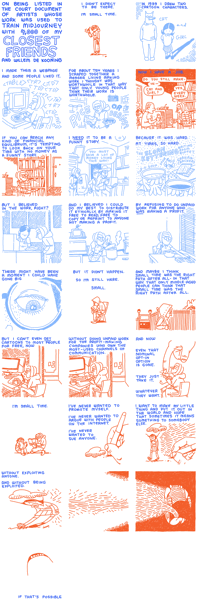
The Markup published an interview of Dorothy Gambrell by Gabriel Hongsdusit, the visual designer of site. It covers a number of topics including the importance of publishing to your own site even as your audience move towards platforms and how publishing on the Internet has changed since she started writing Cat and Girl in 1999.
The main topic of the interview is Gambrell's response to finding out her art was used to train Midjourney, an AI image generation model. She wrote a beautiful piece about her journey as an artist that captures the struggle to make work that you find meaningful and the fear of that work being taken and abused.
I've included it below under the Creative Commons Attribution-NonCommercial-ShareAlike 2.5 License. The final 6 frames are heartbreaking.
This letter made me to the Irish Times made me laugh. I have family in the farming community in rural Ireland and they agreed with the sentiment.

Decoder had a great episode where Hank Green interviewed Nilay Patel, the Editor-in-Chief of The Verge, about his experience of building and maintaining the business. It covers a lot of topics like the state of the media nowadays, why creating content for platforms can be a mistake and the importance of distribution channels.
The Verge focused on their website and building a sense of community that attracted people back to the site. There are many media companies that suffered by allowing social media companies like Facebook, Instagram, Twitter, LinkedIn and YouTube to act as intermediaries between them and their audience. Email and RSS feeds, while not likely to go viral, can provide a more sustainable foundation for businesses to build on.
This does not mean ignoring social media. It builds on the POSSE (Publish Own Site, Syndicate Elsewhere) concept promoted by IndieWeb.
A story that stood out is one where Patel was traveling with Satya Nadella, the CEO of Microsoft. They were going through the list of things that Nadella had done during the day. Patel asked how he got so much done. Nadella looked at him and said:
It's your time. You have to be selfish about it.
Satya Nadella according to Nilay Patel (Guest host Hank Green makes Nilay Patel explain why websites have a future/Decoder)
This reminds me of a quote:
People are frugal in guarding their personal property; but as soon as it comes to squandering time they are most wasteful of the one thing in which it is right to be stingy.
Seneca
Maria Popova wrote a piece on The Marginalian on Seneca and the Shortness of Life that expands on his thinking about this subject.
Damien Dempsey was interviewed on The Fresh Batch podcast and sang Jim Larkin's favourite song, "The Rising of the Moon", towards the end of the episode. This is a similar arrangement on YouTube. A great song for a session.
404 Media published a concerning report that they have obtained internal documents from Automattic that they are preparing to sell user data to Midjourney and OpenAI. Automattic is the parent company of WordPress and Tumblr.
This blog is published using WordPress.com for hosting. I'm going to have to see if there is an opt-out option and to read the terms and conditions attached to that option. If that option is available, I would hope opt-out would be the default option. People should be able to opt-in if they want to. Subterfuge shouldn't need to be used.
A concern raised in the report is that when compiling a data dump from Tumblr for Midjourney/OpenAI, Cyle Gage (a product manager at Tumblr) stated that some data was included that shouldn't have been such as:
Tumblr and Wordpress to Sell Users’ Data to Train AI Tools (Sam Cole/404 Media)
- private posts on public blogs
- posts on deleted or suspended blogs
- unanswered asks (normally these are not public until they’re answered)
- private answers (these only show up to the receiver and are not public)
- posts that are marked ‘explicit’ / NSFW / ‘mature’ by our more modern standards (this may not be a big deal, I don’t know)
- content from premium partner blogs (special brand blogs like Apple’s former music blog, for example, who spent money with us on an ad campaign) that may have creative that doesn’t belong to us, and we don’t have the rights to share with this-parties; this one is kinda unknown to me, what deals are in place historically and what they should prevent us from doing.
The benefit of having my own site is that I can move if I feel like I need to. I'll have to consider other options whether it's moving to a new platform like Ghost or by finding another hosting service.
It is disappointing to see Automattic moving in this direction. They have described themselves as the guardians of the open web but this decision will have people considering whether to remove their Tumblrs or blogs to avoid it being included in a training set for a large language model.
The promise of the open web was that it allowed people to connect with each other in a new way. As Gita Jackson wrote:
The internet has been broken in a fundamental way. It is no longer a repository of people communicating with people; increasingly, it is just a series of machines communicating with machines.
The Internet Is Full of AI Dogshit (Gita Jackson/Aftermath)
This decision by Automattic, if it is true, will make this problem worse in the short term. There's no guarantee that it will improve in the medium to long term either. Companies like OpenAI have made great promises of progress in the past only to renege on them when it suited. Unfortunately, I have little faith that this will be any different.
I could be wrong. I hope that I am.
One of the wonderful things about cover versions is how they can introduce a new audience to an old artist. They can also introduce old audiences to new artists. I had never heard of Luke Combs when he covered Tracy Chapman's "Fast Car" in 2023. Chapman and Combs performed a beautiful duet of the song on during the Grammys in 2024.
Kara Swisher devoted an episode of her podcast, On with Kara Swisher, to the resurgence of interest in Chapman's self-titled debut album since the Combs cover was released titled "Tracy Chapman's Timeless Earworms". Timeless as an apt descriptor because the most notable aspect of Combs' version is how little he changed. It's close to the original version but the song is so good that it can stand on its own over 30 years after it was written.

Hat tip to Yogthos and Brian Krebs for sharing this on Mastodon. It made me laugh.
Josh Wyatt's cover of "Standing Outside the Fire" by Garth Brooks is good.
2023 was a brutal year for layoffs in tech and 2024 has not improved the situation. It can be an incredibly difficult time especially if this is the first time you've been laid off. I was laid off from my first job in tech a decade ago and it's only recently that I've come to realize how much it affected me psychologically.
I came across this series from Joey deVilla, who was laid off from his job as a Senior Developer Advocate for Okta earlier this month. This advice is incredibly important to remember.
If you’ve been laid off — and especially if you’ve been laid off for the first time — you will blame yourself for being laid off. This post is just for you, and it can be summed up as this: you’re probably facing the consequences of someone else’s mistakes.
Laid off in 2024, part 10: Unearned consequences (Joey deVilla/Global Nerdy)
It is hard to reconcile the number of layoffs with the vast profits that the large tech companies have announced over the past few months. It feels unnecessary but it is important to remember that is also a tactic to reset salary expectations in this job market.
I've done a couple of interviews a year to research what the interview process is and how it has changed over time. It is not a process I have ever enjoyed.
Wishing anyone entering the job market all the best.